

The term “plant-wide control” is used here to describe the use of advanced software that sits above (or on top of) the individual PID controllers running a number of process units in a plant.
Depending on the technology employed, this advanced process control software can perform a variety of predictive, scheduling, supervisory and/or optimizing computations. The most common architecture in industrial practice has the plant-wide software compute and transmit set point updates to a traditional platform of individual PID controllers.
| Notes: · Plant-wide control, where one package computes updates for an entire facility, is widely discussed in scholarly articles but is rarely found in industrial practice. · While it is possible for an advanced control package to completely eliminate the need for individual PID controllers, this is also a rare practice. One reason is that advanced software is often an add-on to a plant already in operation. The existing PID controllers provide a distributed backup infrastructure that enable continued operation, including an orderly shutdown, in the event of a computer problem. Even in new construction, plants are normally built with a traditional platform of PID controllers underneath the advanced control software. |
Plant-wide process control holds great allure. The promise is an orchestrated operation for addressing upsets, maximizing throughput, minimizing energy and environmental impact, making scheduling more flexible, and keeping production to a tighter specification.
The figure below illustrates the hierarchy of a more complex multi-level implementation.
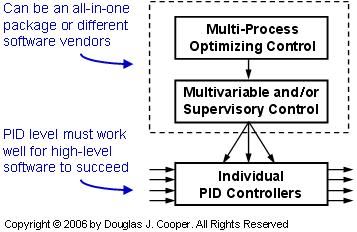
Higher Level Software Uses Longer Time Scales
The individual PID loops of a traditional control system provide the firm foundation for advanced process control. They are designed, implemented and validated as discussed in the dozens of articles on this site. Typical loop sample times for PID controllers on processes with streams comprised of gases, liquids, powders, slurries and melts are often on the order of once per second.
Advanced software sitting above the individual controllers computes and transmits values less frequently, perhaps on the order of once every ten seconds to several minutes. High level optimizers output commands even less often, ranging from once per hour to even once per day. The frequency depends on the time constants of the process units in the hierarchy, the complexity of the plant-level control objectives, the numerical solution methods employed, and the capabilities of the installed hardware.
Project Stages For a Retrofit
Though each implementation is different, projects on existing plants tend to follow a standard progression:
1) Validate all sensors and associated instrumentation; replace where necessary.
2) Service all valves, pumps, compressors and other final control elements to ensure proper function. Replace or upgrade where necessary.
3) Upgrade the DCS (distributed control system) with latest software releases; update hardware if it is aging.
4) Tune all low level PID loops, including cascade, ratio and similar architectures.
5) Upgrade the computers in the control room to modern standards; ensure enough computing power to handle the plant-level software.
6) Design and deploy the plant-level control software.
Note that step 6 is presented as a simplistic single step. In reality, the design and implementation of plant-level software is a complex procedure requiring tremendous experience and sophistication on the part of the project team. Step 6 is presented as a summary bullet item because the purpose of this post is to separate and highlight the vital importance of a properly operating platform of individual PID controllers in any control project.
Steps 1-4 Provide Profitability
Software vendors who suggest that a prospective company consider all steps 1-6 as part of an “advanced process control” project are not being completely transparent.
The return on investment (ROI) may appear attractive for the complete project, but it is appropriate to determine what portion of the return is provided by steps 1-4 alone. The profit potential of these first steps, reasonably characterized as traditional control tasks, can be responsible for well over half of the entire revenue benefit on some projects!
Arguably, it is a better business practice to work through steps 1-4 and then reevaluate the situation before making a decision about the need for and profit potential from plant-level control software.
When the base level instrumentation is in proper working order, the PID loops can be tuned to provide improved plant performance. Rather than using historical tunings, the project team should use commercial software to quickly analyze process data and compute appropriate tuning parameters.
PID Control is The Foundation
As the figure at the top of this post illustrates, the PID loops provide the strong foundation upon which the plant-level software sits.
Plant-wide process control software cannot hope to improve plant operation if the PID loops it is orchestrating are not functioning properly. It is folly to proceed with step 6 above before having worked through steps 1 – 4.
In a great many situations, by the time step 4 is completed, indeed, the plant will be running significantly better. The orderly maintenance and tuning of the first level PID loops will provide a fast payback and begin making money for the company. Quickly.